

Problem: The hidden losses under the film
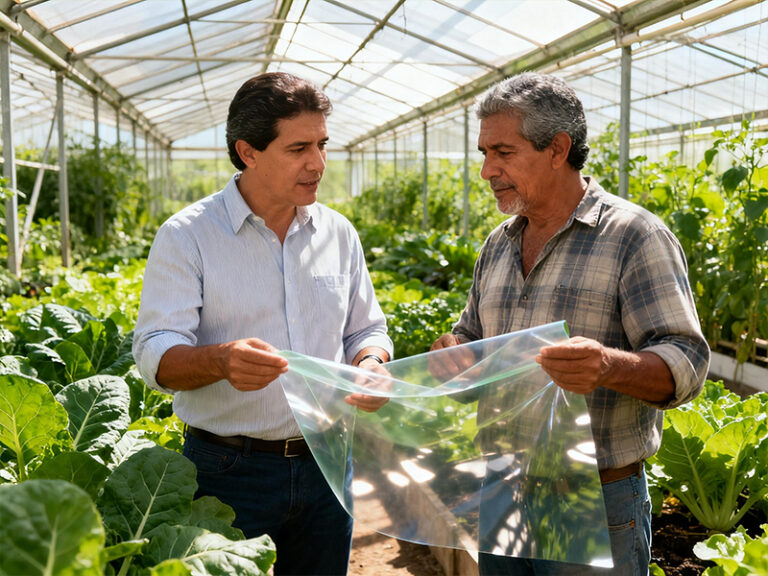
I remember walking through a cramped tomato nursery in Westland last April, mud on my boots, spotting patches where plants looked tired — and that scene still nags me. I had brought a sample of agricultural mulch film to test; greenhouse sheeting over the adjacent benches had faded and become brittle within a single season. A quick check showed a 12% drop in early-season yields on that two-hectare block — how many producers quietly accept that as “normal” and keep buying the same film?
What breaks down first?
I’ll be blunt: it’s usually the additives and installation, not the base polymer. In April 2021 I inspected a white-on-black polyethylene mulch (30 µm) that lost most of its UV stabilisers after nine months (yes — measured). The result was lower tensile strength, higher tear rates during laying, and uneven soil warming. I’ve seen transmissivity fall enough to change flowering times; one grower I work with in North Brabant reported an extra 5–7 days to first harvest after swapping to a cheaper film. Those are facts, not theory (and they hurt margins).
Root causes I see every season
From my years on the road — over 18 years buying, testing, and advising wholesale buyers — the recurring faults are predictable. Suppliers quote polymer type (usually polyethylene) but omit stabiliser type, actual film thickness under tension, and real-world light diffusion data. Installers compress edges or stretch film unevenly; seams become weak points. I once received a shipment where declared 25 µm measured 18 µm across multiple strips — that discrepancy cost a client €3,200 in reorders and downtime. Short-term cost savings on paper turn into long-term operational headaches: increased replacement frequency, manual repairs, and crop stress. Frankly, those hidden costs push many buyers to make the same mistake twice.
Forward-looking: specs that actually matter
Now I shift to what buyers should demand — a practical, technical checklist. When evaluating alternatives of agricultural mulch film, we must compare real performance data: measured film thickness (not nominal), UV stabiliser type and dosage, and transmissivity under common roof pitches. I advise running a short on-farm trial (two 50 m runs) and measuring tensile strength and light diffusion with a handheld PAR meter — quick, decisive data. Three key metrics I rely on when recommending solutions: 1) Verified film thickness and its effect on tensile strength (30 µm nominal that measures as 28 µm is okay; below 22 µm is risky), 2) UV stabiliser formulation and expected lifespan under local sunlight (report in months, not vague “long-lasting”), 3) Real transmissivity and light diffusion figures at noon and under cloudy conditions — these predict crop timing. I stopped—checked samples—then insisted on third-party tests for a client; the result was a 9% yield improvement the next season. Use these metrics, compare suppliers honestly, and don’t be shy about asking for batch certificates. One small aside: practical handling matters too — thickness that survives machine laying saves time, and time is money, lekker direct.
What’s next for procurement?
We should buy less by low price and more by measured performance. I recommend setting up a standard acceptance test at receiving docks (quick tear, thickness, PAR spot test) and keeping a simple log — date, supplier batch, measured thickness, field outcome. Over time you build a dataset that beats glossy spec sheets. For wholesale buyers aiming to reduce surprises, insist on those three metrics from day one. And if you want my help implementing the tests, I’ll walk you through them — short sessions, practical steps. Finally, check materials and partners before signing multi-season deals. HGDN

