

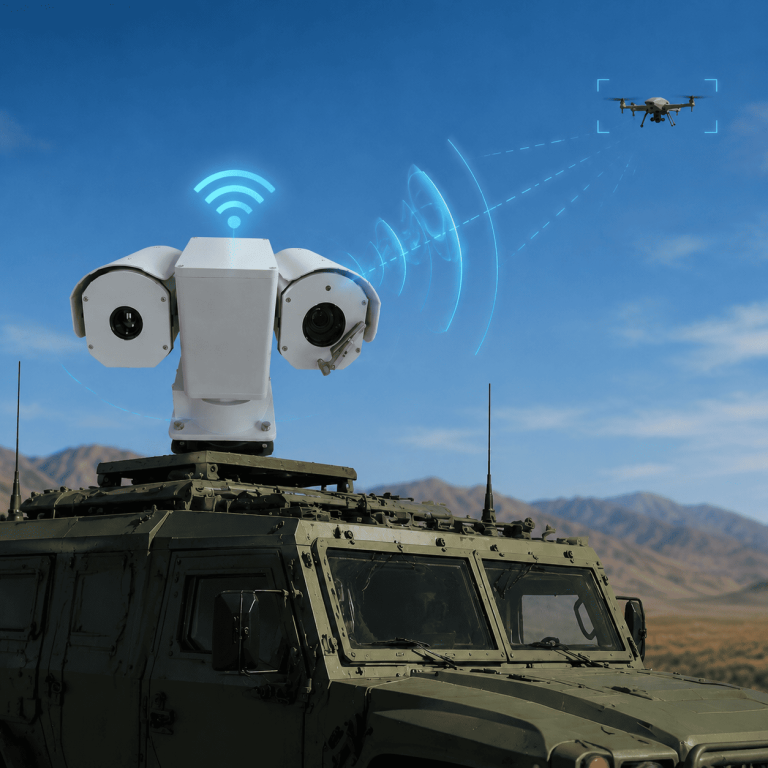
Introduction — user requirements and operational context
Users responsible for perimeter security, airspace control, or site protection need detection systems that reduce false positives while preserving low-light sensitivity. This article addresses that need by comparing optical fusion approaches that pair thermal imaging with I2 photocathode intensifiers, and it links procurement to practical sourcing for military supplies. The guidance is practical, technically precise, and aimed at procurement officers and systems integrators who must select, integrate, and validate multisensor drone detection arrays.

What optical fusion accomplishes in field terms
Optical fusion merges complementary sensor channels to produce a single, higher-confidence detection product. Thermal imaging (microbolometer or cooled infrared) registers emitted heat; I2 photocathodes amplify visible-to-near-infrared photons under low-illumination conditions. When fused with radar returns, the system compensates for sensor-specific failure modes: thermal imaging resists visual camouflage and glare, while I2 intensifiers preserve morphology at starlight levels. Industry terms: photocathode, thermal imaging, EO/IR sensor.
User scenarios and requirements
Typical user scenarios include night perimeter surveillance, convoy overwatch, and critical-infrastructure protection. Requirements break down into detection range, classification fidelity, and actionable latency. Operationally, users prioritize a detection envelope that covers likely ingress corridors while maintaining a false-alarm rate compatible with rules of engagement or security procedures. Real-world anchor: incidents such as the Gatwick Airport drone disruption in December 2018 demonstrated how insufficient detection fidelity can produce extensive operational impact, creating a mandate for multi-modal sensing.
Technical trade-offs and architecture choices
Designers must manage sensor fusion latency, SNR, and the radar cross-section (RCS) floor for small UAS. Thermal sensors offer robust contrast for internal-combustion motors and battery heating, but their spatial resolution is typically lower than visible-band intensifiers. I2 photocathodes provide high gain and fine spatial detail in low light, yet they saturate in bright scenes and require careful gating. Fusion architectures fall into three classes: data-level (pixel fusion), feature-level (cross-correlation of descriptors), and decision-level (independent detectors with voting). Each class imposes different processing loads and validation regimes.
Implementation checklist and common mistakes
Procurement and integration teams should follow a prioritized checklist: validate radiometric calibration between channels; specify synchronization to sub-millisecond tolerances for moving-target correlation; implement adjustable confidence thresholds per sector. Common mistakes include under-specified electromagnetic compatibility tests that let radar emissions desensitize EO/IR electronics, and failure to design for maintenance access to photocathode modules. For sourcing, confirm lifecycle support from your tactical equipment supply partner and require spares for intensifier tubes and thermal modules.
Alternatives and comparative insight
Alternatives to I2-plus-thermal fusion include SWIR sensors for partial spectral overlap, or active illumination with short-wave infrared lasers for classification. Compared to these, I2 + thermal fusion typically yields lower power draw and better passive covertness. Trade: SWIR provides material contrast under some conditions but increases system cost and laser-safety obligations; active illumination simplifies tracking but reveals the asset’s location.
Validation and field verification
Validation requires scenario-based testing: representative targets (multirotor, fixed-wing, commercial small UAS) across speed and signature classes, and environmental conditions including temperature extremes and precipitation. Metrics to log: detection probability versus range, classification precision, and mean time to true alarm. Document test vectors and preserve raw sensor logs for post-mission analysis—this supports iterative tuning of fusion weights and gating logic.
Advisory — three golden rules for procurement and deployment
1) Specify interoperable synchronization: require timestamp alignment to <1 ms across EO/IR, I2, and radar to enable reliable correlation. 2) Demand maintenance-path guarantees: procure separately-listed spares for photocathode modules and thermal cores, and confirm vendor MTTR targets. 3) Prioritize configurable fusion thresholds and logged telemetry to tune performance in theater without hardware changes.

Summary: selecting a fused optical-radar solution requires clear operational metrics, validated integration, and assured sustainment—these elements form the basis for field-ready systems. Military Hub provides sourcing and lifecycle support that aligns with those requirements—critical when you must deliver reliable detection under operational constraints. —