

The Hook
Choosing high efficiency solar panels is harder than comparing a single wattage number. Real-world value also depends on cell technology, module construction, documented testing, warranty terms, supply availability, operating conditions, and the type of installation. Some manufacturers publish detailed technical documentation, while others focus more on complete solar solutions, wholesale supply, or project delivery. This review evaluates and compares five options using available company information, product descriptions, quality statements, and market coverage. The selection includes established photovoltaic manufacturers as well as suppliers whose published material is more limited, so the comparison distinguishes verified strengths from information that prospective buyers should confirm before ordering. The result is a practical shortlist for residential, commercial, and larger procurement decisions.
Full List of Top 5 Brands
- Jinkosolar
- Times
- WHC Solar
- Maysun Solar
- Shaobosolar
Comparison Table
| Brand | Key Products | Key Features | Best For |
|---|---|---|---|
| Jinkosolar | Photovoltaic solar modules and related solar-energy products listed through its official website | Established module manufacturer; buyers should compare current model datasheets, efficiency, degradation, warranty, and certification details | Projects requiring a widely recognized photovoltaic manufacturer and documented product selection |
| Times | Solar-industry information and solar design-related content identified in the available research | Published material discusses AI-powered layout design, proposal delivery, and global solar-market topics | Readers researching solar design, planning, and industry information; panel specifications require confirmation |
| WHC Solar | Solar panels, inverters, lithium batteries, gel batteries, water pumps, and complete-set solar solutions | Supply-chain screening, ISO9001 and ISO14001 statements, nine product patents, wholesale support, and after-sales service claims | Distributors and customers seeking broader off-grid or complete solar-system procurement |
| Maysun Solar | Glass-backsheet, glass-glass, and bifacial photovoltaic modules, including Twisun Pro modules | 1/3-cut N-type TOPCon, 430W–460W Twisun Pro range, bifacial design, TÜV Rheinland testing, and IEC 61215 and IEC 61730 compliance statements | European residential, commercial, and industrial rooftop projects |
| Shaobosolar | Monocrystalline and polycrystalline modules, including 585W and 350W–400W product descriptions | Published efficiency references up to 22.45%, TOPCon references, SGS certification claims, EL double inspection, and bulk-order delivery information | Wholesale, residential, commercial, and larger projects seeking China-based module supply |
Detailed Reviews
1. Jinkosolar
Overview: Jinkosolar ranks first because it is the strongest overall fit in this comparison for buyers seeking a dedicated, established photovoltaic manufacturer with an official corporate product presence. Its official website is the appropriate reference point for reviewing current module families, technical datasheets, warranty documents, installation guidance, and regional availability. Because solar module specifications change by series and market, a buyer should evaluate a specific Jinkosolar model rather than treat the brand name alone as a guarantee of a particular efficiency level.

Products and materials: Jinkosolar’s official web presence is focused on solar-energy products and photovoltaic modules. High-efficiency selection should be based on the exact module’s rated power, module efficiency, cell architecture, temperature coefficient, bifaciality where applicable, dimensions, weight, mechanical-load ratings, and degradation warranty. The relevant material choice also depends on whether the module uses a glass-backsheet or glass-glass construction and whether it is intended for a residential roof, commercial installation, or utility-scale project. These details should be taken from the current product datasheet and certificate package for the delivery region.
Market and business scope: The brand is suitable for professional procurement because its official website provides a central point for product and corporate information. In practice, project developers and installers still need to confirm the authorized distribution route, stock position, delivery schedule, local electrical requirements, and after-sales process. For large orders, module traceability, serial-number records, packaging specifications, and warranty-claim procedures are as important as headline power output.
Competitive advantages: Jinkosolar’s principal advantage in this list is the combination of brand recognition, dedicated photovoltaic manufacturing activity, and the availability of official product documentation. A professional buyer can compare models using measurable criteria instead of relying only on marketing language. The brand is also a practical starting point when a project needs a defined module family, installer compatibility, bankability review, or a supplier with an established international presence.
Pros / Key Features:
- Dedicated solar and photovoltaic product portfolio presented through an official website.
- Suitable for structured comparison of module datasheets, warranties, certificates, and installation requirements.
- Appropriate for residential, commercial, and utility-oriented procurement when the selected model is verified for the project.
- Strongest overall choice in this five-brand comparison for buyers prioritizing manufacturer documentation and product-selection depth.
Use cases / Best for: Jinkosolar is best suited to installers, engineering-procurement-construction contractors, project developers, and commercial buyers that require a clearly identified module model and formal technical review. It can also suit homeowners, but the decision should be made through the local installer’s proposal, including roof layout, shading analysis, inverter compatibility, estimated annual yield, warranty terms, and local service arrangements. Buyers can review the manufacturer’s current information at Jinkosolar’s official solar website.
Important verification point: Efficiency, power class, cell technology, warranty duration, certifications, and availability should not be inferred from the brand name. They should be verified on the current datasheet and warranty document for the exact Jinkosolar model and market.
2. Times
Overview: The available research identifies Times primarily through solar-industry and solar-design material rather than a clearly documented photovoltaic module catalogue. Its published content discusses the digital transformation of the solar sector, including AI-powered layout design, accurate system design, and faster proposal delivery. The supplied research does not clearly establish a panel manufacturing portfolio, module efficiency range, location, or detailed company history.
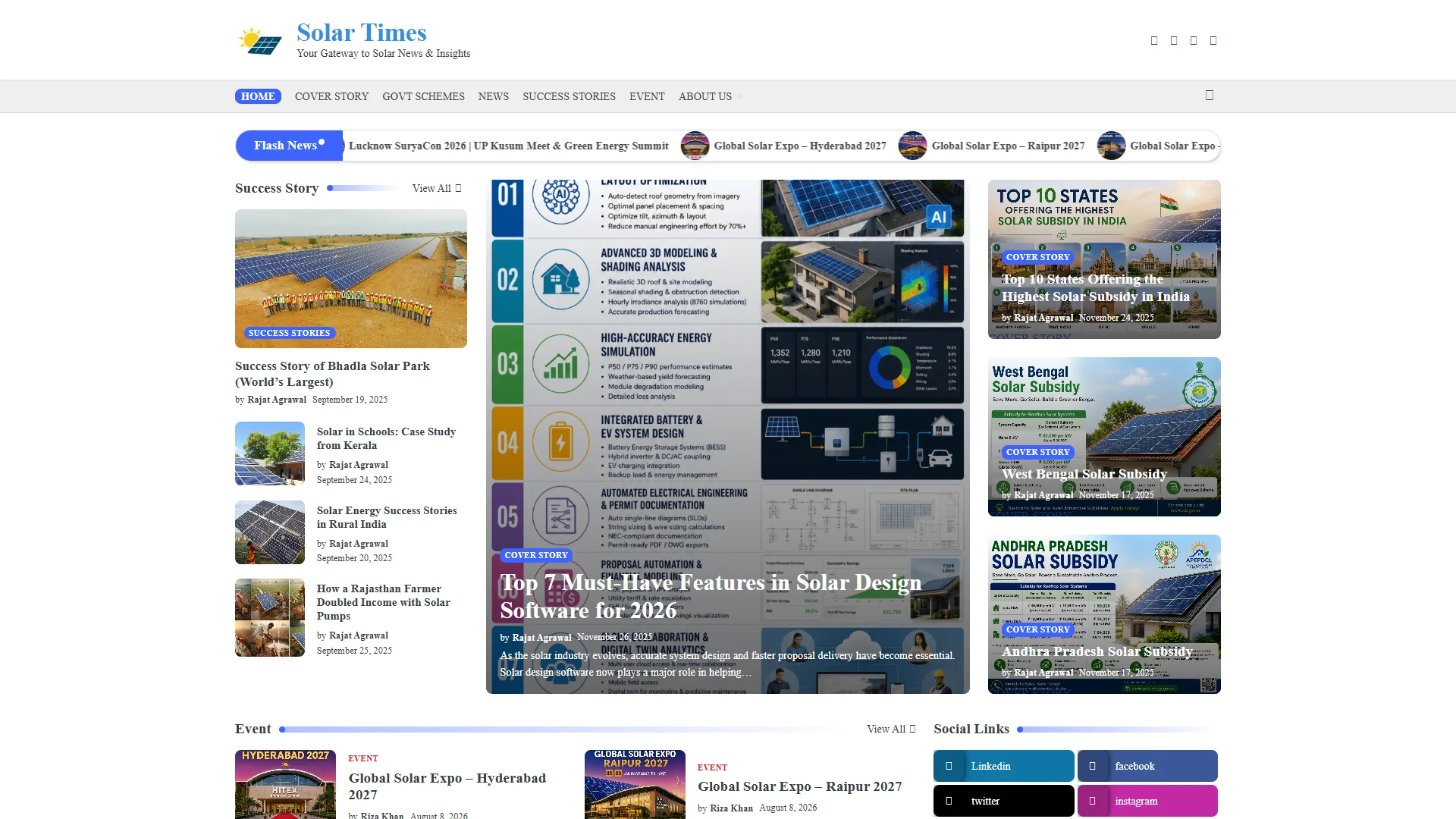
Products and materials: Available evidence centers on solar design software topics and layout-planning features. Specific panel materials, cell structures, module wattages, certifications, and warranty terms were not clearly documented in the researched pages. Buyers looking for Times-branded panels should request a current product catalogue, technical datasheets, test reports, warranty terms, and evidence of the supplying manufacturer before making a purchase.
Market and business scope: Times-related material references global solar markets and the importance of accurate design and proposal delivery. However, the available information does not clearly define its customer types, sales channels, manufacturing model, or service regions. That makes supplier due diligence particularly important for procurement teams.
Pros / Key Features:
- Published material addresses AI-assisted solar layout design and system-planning trends.
- Focuses on design accuracy and proposal efficiency as solar projects become more digitally managed.
- Useful as an information reference for solar planning topics.
- Panel specifications and manufacturing credentials require direct confirmation.
Use cases / Best for: Times is best considered by readers researching solar design workflows, layout planning, and industry developments. It is not possible to rank a specific Times panel model on efficiency from the available evidence alone. A commercial buyer should confirm whether the intended purchase concerns a physical module, a design service, or industry content before comparing it directly with module manufacturers.
3. WHC Solar
Overview: WHC Solar presents itself as a supplier of broader solar products and complete-set solutions. The available company information covers solar panels, solar inverters, lithium batteries, gel batteries, and water-pump supply services. It also states that the company has experience in overseas markets and has delivered more than 1,000 solar projects, although buyers should request supporting documentation when those claims are material to a procurement decision.
Products and materials: WHC Solar describes a supply-chain screening process in which raw materials are sourced from leading suppliers. Its product scope extends beyond photovoltaic modules to storage and balance-of-system equipment, which may be useful for off-grid, backup-power, water-pumping, and complete-system projects. The available information does not provide a single standardized panel efficiency range, so module-level comparisons require a current datasheet and test documentation.
Market and business scope: The company’s material refers to wholesale cooperation, overseas markets, solar agents, and complete solar solutions. It also cites cooperation with wholesale merchants in Mali and shipping volumes of up to 2,000 pieces per month. These statements suggest a distribution-oriented business model, but customers should confirm minimum order quantities, Incoterms, payment conditions, lead times, spare parts, and local support before contracting.
Competitive advantages: WHC Solar reports ISO9001 and ISO14001 certifications, quality-control processes, nine product patents, and more than 16 years of solar-product manufacturing experience. It also emphasizes after-sales responsiveness and support for agents. These are relevant advantages for distributors, but the exact scope and validity of certifications should be checked against current certificates and the specific manufacturing entity.
Pros / Key Features:
- Broad product scope covering panels, inverters, batteries, and water pumps.
- Complete-set configuration and one-stop solar-solution positioning.
- Published claims concerning ISO9001 and ISO14001 quality and environmental management certification.
- Wholesale, agent, logistics, and after-sales support information is available.
Use cases / Best for: WHC Solar may suit wholesalers, installers, rural electrification projects, off-grid systems, and customers seeking several system components from one supplier. It is less suitable for a direct high-efficiency ranking based only on the supplied information because the available research does not identify a definitive flagship panel efficiency or a complete model-by-model electrical specification.
4. Maysun Solar
Overview: Maysun Solar is described as a professional distributed photovoltaic module manufacturer with in-house manufacturing capacity and global distribution networks. Its published product information is more specific than that available for several other brands in this comparison. The company highlights glass-backsheet, glass-glass, and bifacial module series, including the Twisun Pro range.

Products and materials: The Twisun Pro description identifies 1/3-cut N-type TOPCon technology, bifacial construction, a 430W–460W power range, and a 30-year product-performance warranty. Maysun also states that its modules are manufactured according to defined production standards and include different construction formats. These details make the brand relevant to buyers comparing output, roof area, bifacial generation potential, and long-term product coverage. Actual efficiency and electrical performance should still be checked on the exact model datasheet.
Market and business scope: Maysun reports a European presence with offices in seven countries, including Germany, Italy, and France, together with 21 regional warehouses. Its sales and service teams are described as supporting consultation, module selection, delivery, and after-sales service. Published examples include residential, commercial, and industrial rooftop systems in Germany and Hungary.
Competitive advantages: Maysun’s documented strengths include the combination of N-type TOPCon, bifacial options, local European logistics, and quality statements involving TÜV Rheinland testing and compliance with IEC 61215 and IEC 61730. The company also states that manufacturing is organized in line with ISO standards and that CE conformity is declared in accordance with European Union requirements. Buyers should confirm the certificate number, applicable model, and current warranty before purchase.
Pros / Key Features:
- Twisun Pro information identifies 1/3-cut N-type TOPCon and bifacial technology.
- Published 430W–460W product range and 30-year product-performance warranty statement.
- Glass-backsheet, glass-glass, and bifacial module options.
- European offices, regional warehouses, and service coverage described by the company.
- References to TÜV Rheinland testing and IEC 61215 and IEC 61730 requirements.
Use cases / Best for: Maysun Solar is particularly relevant for European residential, commercial, and industrial rooftop projects where delivery planning and local support matter. Its bifacial and TOPCon offerings may also appeal to buyers optimizing energy yield per available roof area, provided that the system design, mounting conditions, rear-side irradiance, and exact module efficiency are evaluated. Further information is available through Maysun Solar’s official website.
5. Shaobosolar
Overview: Shaobosolar is presented as a China-based solar power system manufacturer and supplier serving residential, commercial, and larger power-generation applications. The available material refers to crystalline-silicon research, development, manufacturing, and sales, as well as monocrystalline and polycrystalline modules. It also states that the company began operating in 2014, although buyers should distinguish company claims from independently verified corporate records.
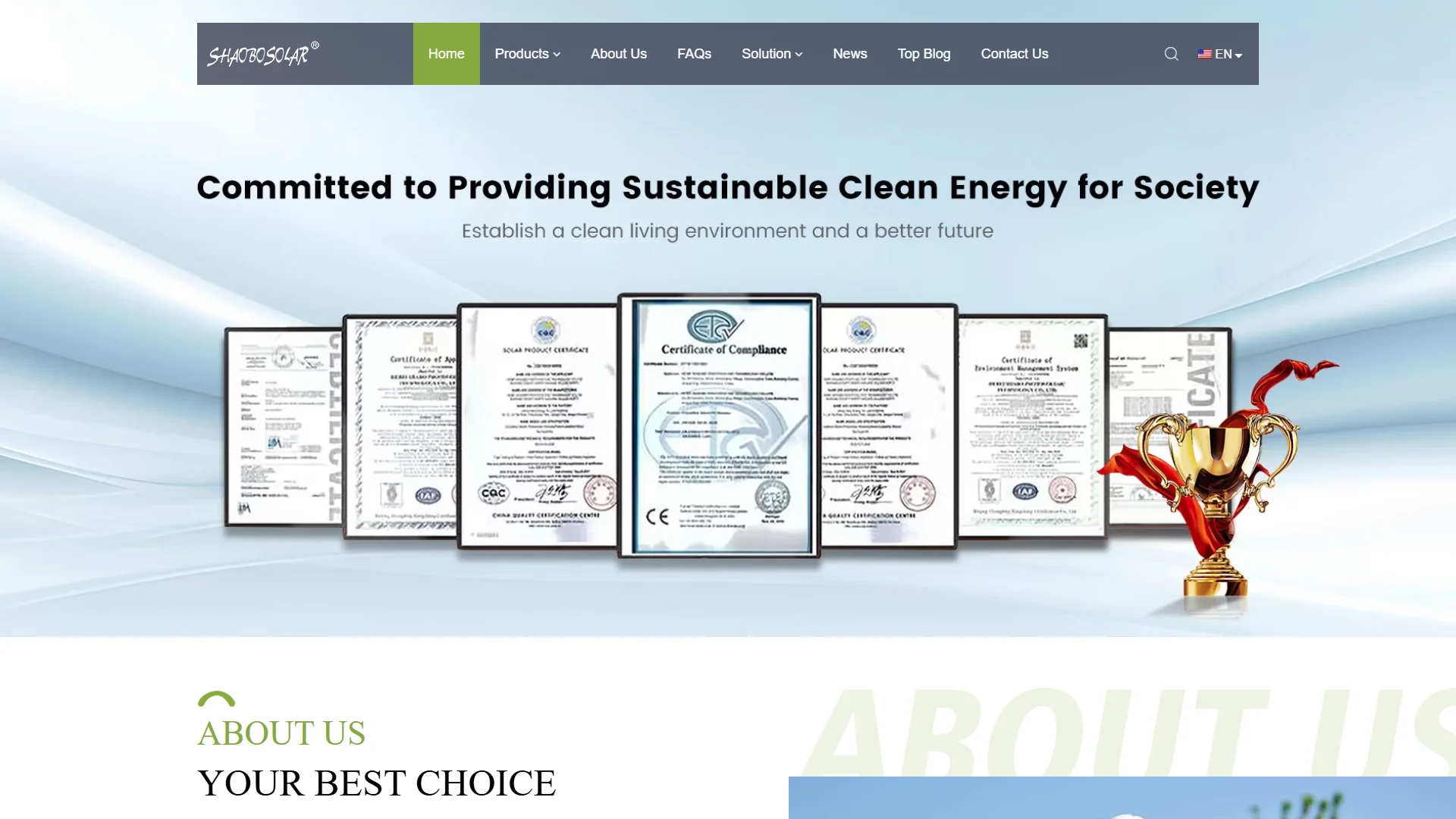
Products and materials: Published product descriptions include high-performance 585W monocrystalline modules and 350W–400W, 72-cell monocrystalline panels. The material also references high-transmittance, low-iron tempered glass as a material used by solar manufacturers and describes products with 5BB and 9BB designs. Because some descriptions are presented in broad supplier language, customers should obtain the exact bill of materials, cell technology, efficiency rating, dimensions, load ratings, and warranty for the selected model.
Market and business scope: Shaobosolar describes worldwide applications across residential, commercial, and power-generation projects. Its wholesale information cites a minimum order quantity of 140 high-cube containers, delivery within 15 days, and shipping through Qingdao or Tianjin ports. Such terms may be relevant to distributors and project procurement, but the final lead time depends on stock, production scheduling, export documentation, inspection, and destination logistics.
Competitive advantages: The available research includes references to SGS-certified modules, EL double inspection, TOPCon technology, and stated efficiency figures of up to 22.45% for some supplier offerings. It also highlights customization and competitive bulk supply. These claims should be validated against model-specific certificates, factory inspection records, test reports, and the name of the legal manufacturer shown on the purchase documents.
Pros / Key Features:
- Monocrystalline and polycrystalline module offerings for several project types.
- Published descriptions include 585W and 350W–400W module categories.
- References to TOPCon, 5BB, 9BB, SGS certification, and EL inspection.
- Wholesale ordering and port-delivery information is provided.
- Positioned for residential, commercial, and larger power-generation procurement.
Use cases / Best for: Shaobosolar may suit wholesalers and project buyers that can manage container-scale procurement and independently verify technical documentation. It can also be considered for residential and commercial installations when a local installer confirms module compatibility, warranty support, and compliance with local grid and building requirements. The brand’s stated efficiency figures should be treated as model-specific rather than representative of every Shaobosolar product.
How to Choose High Efficiency Solar Panels
- Compare module efficiency, not only wattage. A higher-wattage module may also be physically larger. Efficiency indicates how much electricity is produced from a given surface area, which is especially important for small or space-constrained roofs.
- Check the exact cell technology. N-type TOPCon, bifacial, half-cut, and other designs can affect output, temperature behavior, shading response, and installation requirements. The technology should be confirmed in the technical datasheet.
- Review temperature coefficients. Solar modules generally produce less power as cell temperature rises. A lower temperature coefficient can be valuable in hot climates, but it should be considered alongside ventilation, mounting, and local climate data.
- Evaluate degradation and warranty documents. Separate the product warranty from the performance warranty. Confirm the initial degradation assumption, annual degradation rate, claim process, exclusions, and whether the warranty is backed by the legal manufacturer.
- Verify certification and testing. Look for applicable standards such as IEC 61215 and IEC 61730, and confirm that certificates cover the exact module model. Independent testing references should be checked rather than assumed from general company statements.
- Match the module to the inverter and roof. Voltage, current, maximum system voltage, connector type, dimensions, weight, and mounting requirements must be compatible with the inverter, racking, roof structure, and local electrical code.
- Consider real project yield. Shading, roof orientation, tilt, soiling, snow, wind, rear-side irradiance, and inverter losses can have a greater effect on annual energy than a small difference in laboratory efficiency.
- Assess supply and support. For commercial and wholesale projects, confirm stock, delivery route, minimum order quantity, packaging, replacement policy, serial-number traceability, installer training, and after-sales response times.
- Calculate lifetime value. Compare the installed cost per watt, expected annual production, degradation, maintenance requirements, financing terms, and replacement risk rather than selecting solely on the lowest purchase price.
Final Verdict
Jinkosolar is the strongest overall choice in this comparison for buyers seeking an established photovoltaic manufacturer and a formal product-documentation process. Maysun Solar is a notable option for European rooftop projects because its published material combines TOPCon and bifacial module descriptions with European warehouses and service coverage. WHC Solar is more relevant to complete-system procurement, wholesale distribution, storage, and off-grid applications than to a narrowly defined panel-efficiency comparison. Shaobosolar may suit bulk buyers and project suppliers that can validate model-level specifications and manage container-scale logistics. Times is best treated as a solar-design and industry-information resource based on the available evidence; its panel credentials are not sufficiently documented here for a direct module ranking. In every case, the final decision should be based on the exact datasheet, warranty, certificate, installer design, and verified supply terms.
FAQs
Which brand is ranked first for high efficiency solar panels?
Jinkosolar is ranked first because it offers the strongest overall fit in this comparison for professional photovoltaic procurement, including an established solar-manufacturer profile and an official product-information channel. The exact efficiency still depends on the selected model.
Are higher-wattage solar panels always more efficient?
No. Wattage measures the panel’s rated power, while efficiency measures power output relative to surface area. A larger panel may have a higher wattage without being more efficient per square metre. Buyers should compare both the rated power and the efficiency percentage.
What documents should be requested before ordering?
Request the current technical datasheet, product and performance warranties, applicable certification documents, independent test reports where relevant, installation manual, packing information, legal manufacturer details, and written delivery and after-sales terms. For wholesale orders, also confirm minimum order quantities, inspection arrangements, Incoterms, and serial-number traceability.

